
Vienna Call to Action
On green industrialization, sustainable
energy, climate and security
Purpose
Prepared by the co-organizers; informed by consultations with stakeholders of the IVECF 2026, reflecting key messages and calls for delivery.
Introduction
Current developments, including rising energy insecurity, increasing economic vulnerabilities, intensifying competition and tension over fossil fuels and critical minerals, persistent energy poverty in parts of the Global South, and the accelerating impacts of climate change on people and critical infrastructure are placing significant strain on global security, stability, and human well-being and creating uncertainty in global trade while slowing down GDP growth.
These challenges are particularly acute for Least Developed Countries (LDCs), Landlocked Developing Countries (LLDCs), and Small Island Developing States (SIDS), which often remain dependent on fossil fuel imports, lack climate-resilient infrastructure and must operate within constrained financial capacity.
At the same time, rapid technological breakthroughs in sustainable energy, resource efficiency, system design, green industrialization, and climate adaptation present an important opportunity for the transition to a more sustainable and equitable global green business model. This new paradigm requires solidly integrating just energy transition strategies into strategic industrial policy. This new paradigm is based on the principles of multilateral collaboration and regional integration as well as a commitment to delivering shared benefits at the national level.
Its success depends on deliberate planning as a tool to deliver investments and drive concrete action. Gender equality, social inclusion, and meaningful youth participation are central drivers of effective, equitable, and resilient green industrial development.
Multilateral cooperation and integrated solutions, ones that address the diverse circumstances of developed countries, emerging markets and developing economies (EMDEs), and especially LDCs, LLDCs, and SIDS, while putting people centre-stage, remain indispensable for advancing a fair global transition. Regional, South-South, and Triangular cooperation is essential for accelerating joint progress by advancing knowledge exchange on mutually agreed terms, technology cooperation, and economies of scale.
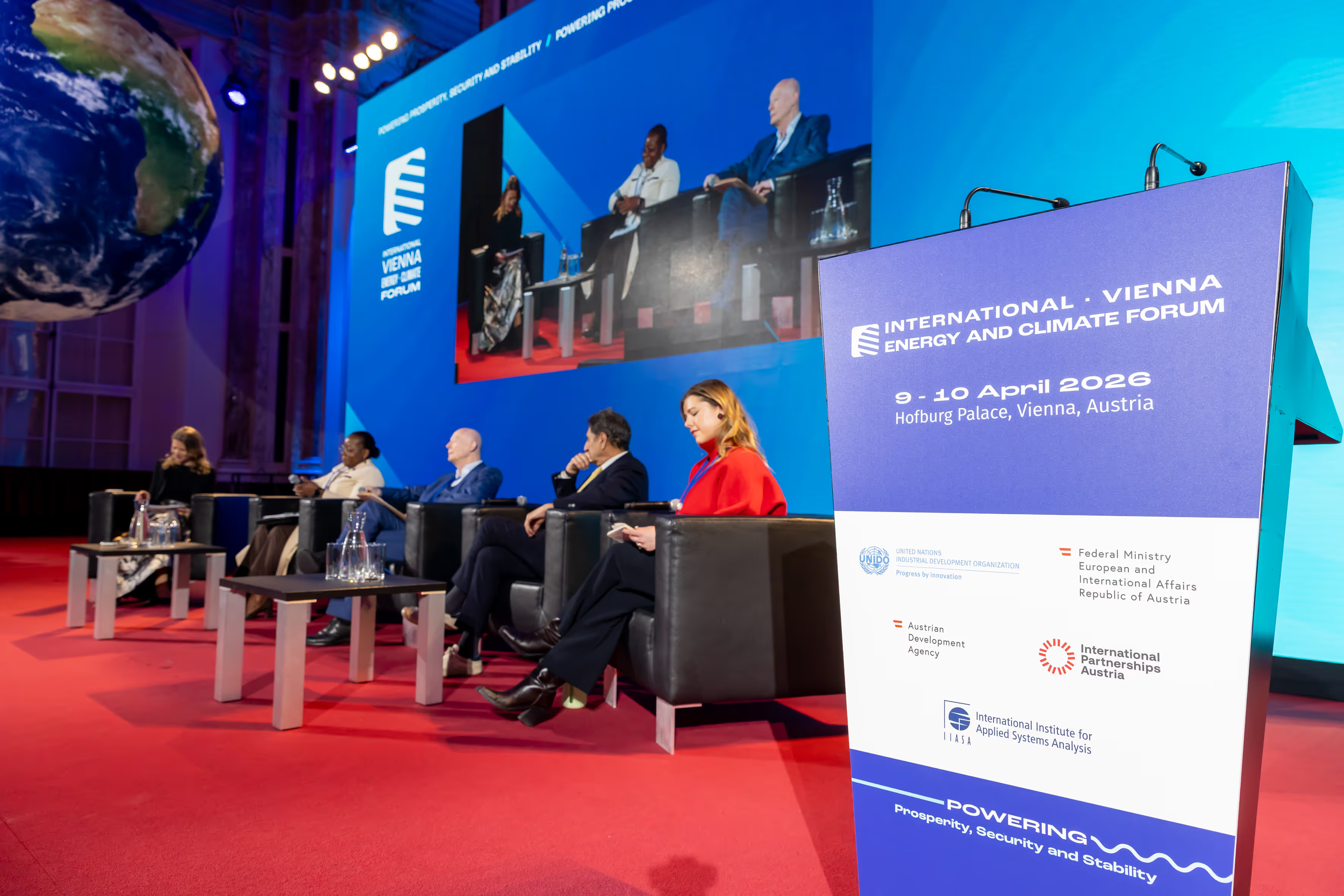
Since its inception, the International Vienna Energy and Climate Forum serves as a multilateral platform that brings together diverse stakeholders to discuss the role of sustainable energy in development. In 2026, the forum presents a new vision where the just energy transition, green industrialization and climate resilience are core pillars to deliver security, stability and prosperity in the face of growing global uncertainty.
Our Vision for Prosperity, Security and Stability
We envision a world where rising geopolitical tensions and accelerating climate risks no longer threaten the foundations of economic security and stability but galvanize a global transformation. A world where every nation, especially the most vulnerable, including LDCs, LLDCs and SIDS chart a pathway towards a resilient and prosperous future. In this vision, the just energy transition is a catalyst for empowerment and poverty reduction, green industrialization is a driver of opportunities for new industries and new skills. Climate resilience is a cornerstone of stable societies and thriving economies.
We believe in a global community that embraces the transformation by investing in sustainable energy systems, building climate-resilient economies while ensuring no one is left behind, no country, no community or group, including those in rural and remote areas.
Achieving this vision requires that the pathway to stability and growth is built on fairness and innovation. A future where the countries most vulnerable today become the best prepared requires collective action to reduce poverty, strengthen resilience and unlock inclusive and sustainable development.

Action Agenda
Building on multilateral dialogue and the partnerships fostered throughout the Forum, this Action Agenda sets out concrete priorities, collaborative measures and actionable pathways to translate ambition into tangible results. It places particular attention to the needs of vulnerable countries and communities, including LDCs, LLDCs, SIDS and fragile or crisis‑affected settings, and marginalized groups, and recognizing gender equality and youth participation as essential drivers of a just transition.
Cross-cutting Actions
Advance national implementation agendas at the energy-industry-climate-security
nexus: Call on governments to align sustainable energy, green, climate resilience, trade,
finance, and social inclusion within coherent national frameworks to leverage policy
coherence, supported by predictable policy signals, robust institutions, and effective
implementation mechanisms.
Scale coordinated international support for EMDEs, LDCs, LLDCs, SIDS and fragile or
crisis‑affected settings: including project preparation, standards, technology cooperation,
skills development and institutional capacity‑building with particular attention to LDCs,
LLDCs, SIDS and fragile settings.
Promote a fairer international funding system by applying vulnerability responsive finance
to align multilateral financing with the particular needs of LDCs, LLDCs, and SIDS.
Mobilize long‑term and catalytic capital: While the private sector must drive the majority of
transition investments, public finance remains a catalyst, deploying smart concessional
finance, risk-mitigation instruments, and innovative mechanisms to address incremental
costs of clean technology and climate resilience premiums.
Advance regional, South-South, triangular cooperation, and cross-regional platforms as
accelerators of decarbonization, just energy, climate and green industrial transitions,
fostering innovation, replication, and market-driven economies of scale.
Promote gender equality, youth participation and local entrepreneurship as cross-cutting
drivers of delivery and inclusive outcomes.
Green Industrialization Actions
Operationalise the Belém Declaration on global green industrialization: Support a
multi‑year implementation plan organized around knowledge creation, international dialogue
and country‑driven delivery support that accelerates action.
Leverage middle‑income countries as role models and drivers: Scale South‑South and
triangular cooperation platforms for policy replication, technology diffusion and
co‑investment with LDCs, LLDCs and SIDS, including through co‑investment platforms and
joint ventures in low‑ and lower‑middle‑income countries.
Promote sector‑wide industrial transition programmes: Adopt programmatic approaches
in heavy‑emitting sectors that aggregate demand for low‑emission materials, reduce
emissions intensity and unlock competitive exports, while reskilling and ensuring social
protection of at-risk workers.
Develop sustainable industrialization hubs and clusters: Create integrated ecosystems
powered by clean energy and shared infrastructure, using coordinated procurement,
industrial aggregation, harmonized standards and credible buyer linkages.
Strengthen green skills, innovation systems and entrepreneurship: Build demand‑driven
skills systems and inclusive entrepreneurship support so that MSMEs, women‑ and youth‑led
enterprises can participate in green value chains through technical and vocational education
and training (TVET) systems and universities.
Just Energy Transition Actions
Achieve universal access to sustainable and affordable energy and clean cooking
services by 2030: Advance access with a focus on productive uses in rural and remote areas,
with particular focus on LDCs, LLDCs and SIDS.
Embed just energy transitions within national industrial policies and mobilize all
available talent, including that of women and youth: Promote policy coherence and
empower the local private sector to engage in global value chains for sustainable energy
manufacturing and servicing – leveraging renewable energy and critical mineral potentials to
generate local green jobs and revenue.
Strengthen regional cooperation and integration as a central accelerator for just energy
transitions: Support the creation of integrated and inclusive regional sustainable energy
power, product and service markets by strengthening power pools and the UNIDO hosted
Global Network of Regional Sustainable Energy Centres (GN-SEC), which is attached to the
regional economic communities (RECs).
Climate Resilience Actions
Make climate-resilient low-carbon infrastructure planning a global standard: Climate risk
assessments to be applied for all development plans, infrastructure programmes and
industrial strategies, while regulations and permitting are updated and coordination is
strengthened across finance, industry, energy, environment, and planning authorities.
Promote resilient technologies and adaptive industrial processes: Resilient energy and
industry systems, adaptive processes, water-efficient production, distributed generation,
resilient materials, and digital monitoring should be prioritized - including nature-based and
ecosystem-based solutions that protect infrastructure and industrial value chains.
Strengthen resilient markets and supply chains: Climate resilience should be embedded in
supply-chain strategies, industrial upgrading and export positioning, while quality
infrastructure and MSME
Targeted actions for LDCs and LLDCs
Harness the benefits of green industrial agglomeration as a tool to drive economic
diversification toward high-value-added manufacturing and servicing, reduce dependence on
vulnerable fossil-fuel supply chains and exposure to price volatility, and advance
decarbonization across industrial and energy systems.
Green Economic Corridors as engines for green industrialization: Call on UNIDO to
support corridor organizations in integrated sustainable-energy, transport and industrial
planning, and to leverage regional renewable-energy and critical-mineral-potential for
cleantech manufacturing, in support of initiatives such as the Lobito Corridor, the ECOWAS
Clean Energy Economic Corridor and the Mano River Union Corridor.
Provide continued support to the LDC Group on Climate Change and encourage UNIDO
and GEF to extend similar institution building assistance to the new LLDC Group on Climate
Change, fostering synergies with Vienna based international organizations.
Targeted actions for Small Island Developing States (SIDS)
Integrated SIDS approaches: Strengthen the adaptive capacity of SIDS energy systems
through climate-resilient renewable energy systems, thereby reducing the fiscal and foreign-
exchange burden of imported fossil fuels, enhancing energy security, reducing GHG
emissions, and generating productivity gains and adaptation co-benefits for key value chains
such as tourism, fisheries, and agriculture.
Advance the Global Programme on Climate-Resilient Renewable Energy Systems for
SIDS (G-RES), a multi-country initiative that supports SIDS in transitioning to resilient
renewable energy systems by facilitating SIDS-SIDS cooperation, knowledge sharing,
harmonised technical standards, and blended-finance mechanisms that reduce barriers to
private-sector investment.
Call for a SIDS Ministerial meeting on the Antigua and Barbuda Agenda for SIDS (ABAS)
implementation and encourage partners of the IVECF to convene a dedicated meeting
focused on climate-resilient blue-green growth in SIDS.
Building sustainable futures for crisis, recovery and reconstruction
Align crisis recovery with green transformation by prioritizing resilient infrastructure,
decentralised sustainable energy, and the restoration of local manufacturing and job creation
for displaced populations, women, and youth, while aligning humanitarian, development,
climate, and industrial agendas.
The Way Ahead
We call on all IVECF participants and partners to use this Call to Action as a reference for
further engagement and cooperation to turn the green energy transition into an economic
opportunity that strengthens resilience and delivers security, stability and prosperity. We
invite everyone to use this call as a reference for engagement in national, regional, and
international policy processes including the High-Level Political Forum on Sustainable
Development and to inform broader discussions on a post-2030 development agenda.
Discussions at the IVECF have re-emphasised the importance of integrated and systemic
multilateral approaches, addressing the transition toward sustainable energy, green
industrialization, and climate resilience together with security, stability, and prosperity in a
coherent and mutually reinforcing manner.
We will continue to convene partners to advance the green industrialization agenda and further work jointly on a more sustainable and equitable global green business model as a fundamental pillar for security, stability, and prosperity for all.