
Stop for a moment.
Imagine your life 25 years from now, living in the exact same building you are in today. The global average temperature has crept to “only” 1.8°C above pre-industrial levels, but some regions (maybe yours?) experience twice that warming. Outside, tropical nights have tripled, and urban heatwaves strike with unprecedented, suffocating intensity. Flash floods overwhelm aging streets and drains. Inside, you face rare but prolonged electricity outages while relying on aging fossil-fuel heating and inefficient, or non-existent, air conditioning. Meanwhile, energy prices have skyrocketed, with energy bills consuming an ever-larger share of your income. Your home, meant to be a sanctuary, has become a thermal trap.
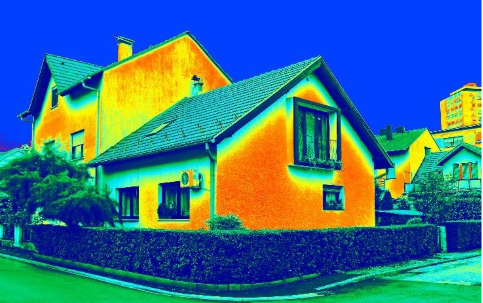

This picture feels painfully dystopian. We still have the power to move away from this trajectory, but only if we move fast and on all fronts.
Most of the public debate gravitates toward alternative fuels, grid decarbonization, electric vehicles, and batteries, which are arguably the more technology-driven solutions towards climate neutrality. Yet buildings account for roughly 40% of global energy- and process-related CO₂ emissions, making them the sector we can least afford to overlook. If we are serious about staying as close as possible to the Paris Agreement’s 1.5°C target, transforming how we design, construct, heat, cool, and renovate our buildings is not optional.
Here is what the latest science tells us about how we get this done.
Don’t lock-in the problem, build to last
To understand the challenge, we have to look at how buildings use energy. Currently, three-quarters of building emissions come from operational energy use, mainly heating, cooling, and ventilation.
While we have the technology to reduce these impacts, the building sector moves slowly. Buildings are long-lived assets. Decisions made today lock in emissions for decades. In fact, an estimated 80% to 90% of the buildings standing today will still be in use by mid-century. A large share of these were constructed long before modern thermal regulations even existed. Significant market barriers, many of which distort incentives, are blocking what would be promising pathways to modern renovations and highly energy-efficient new buildings. These range from financial hurdles (e.g., high upfront costs) and complicated decisions (e.g., split incentives between owners and tenants) to project delays (e.g., fragmented supplier offers).
As operational emissions slowly decrease through efficiency gains, a new challenge is coming into sharper focus: "embodied carbon", which comprises the emissions from manufacturing materials, construction, and eventual building demolition.
The tools are already at hand
The good news is that the pathway to building sector decarbonization doesn't require major innovations, new technologies or policies to mature.
- Empowering the demand side: A 2025 study in Climatic Change by Alessio Mastrucci and colleagues found that rolling out already-tested demand-side policies focusing on behavior change, cleaner fuels, and improved existing technology could halve operational emissions, reducing global CO₂ from residential heating and cooling by 57% by 2050. Paired with aggressive overarching climate policies, that reduction could climb as high as 91%.
- Rethinking materials: We have to look beyond the energy a building consumes, because major emissions and material reductions are offered when we look at what it is made of. Shifting toward bio-based materials like mass timber also has the potential to effectively turn buildings into long-term carbon sinks. Research by Nicolas Alaux and colleagues in 2025 demonstrated that the life-cycle greenhouse gas emissions of the EU building stock could drop by up to 72% by 2050.
- Fixing the system: Technology alone will fail without the right economic engine. The EU’s current tax structure disproportionately favors fossil fuels over electricity and biomass, with substantial cross-country disparities, actively working against the very transitions it nominally supports. Current flagship policies, such as the EU Emissions Trading System 2 (ETS2), adopted in 2023 to expand the existing cap and trade system to end-use sectors (buildings, transport and small industry), fall short on their own. Vivier and colleagues show that achieving the decarbonization target requires 90 million heat pumps to be installed across Europe by 2050. Getting there demands a robust carbon tax to curb overconsumption, paired with sizable subsidies for renovations and heat-pumps, and a serious rationalization of the levies that currently make fossil fuels the cheaper choice.
The golden rule: demand first
The science is clear: reducing energy and material demand first makes most sense. By prioritizing technological efficiency, service improvement, as well as social and system restructuring (like rethinking building ownership models), we can drastically reduce pressure on the upstream supply. Decarbonizing a highly efficient, downscaled energy grid is considerably easier than trying to generate enough green energy for high demand and massive waste. It also limits our reliance on engineered carbon removal technologies, which remain costly, unproven at scale, and carry serious feasibility risks. A demand-first perspective doesn't just cut green-house gases; it alleviates energy poverty, reduces grid strain, and fundamentally improves human comfort and health.
Moving from commitments to implementation
As of 2026, 114 countries have adopted net-zero legislation or binding commitments, covering 92% of global emissions. But pledges on paper do not insulate attics or install heat pumps. Action on the ground still lags upsettingly behind.
Initiatives like the EDITS project (Energy Demand changes Induced by Technological and Social innovations) are bridging the gap between research and action, connecting policymakers, practitioners and researchers across regions to identify what demand-side solutions work, and why so many still stall at implementation.
We have the blueprints. We have the evidence. What remains is the political will, the private investment, and the cross-sector collaboration to build and retrofit our way to a safer world.
References
Mastrucci, A., Boza-Kiss, B., van Ruijven, B. (2025). Towards net-zero emissions in global residential heating and cooling: a global scenario analysis. Climatic Change DOI: 10.1007/s10584-025-03923-6
Alaux, N., Steinberger-Maierhofer, D., Bechstedt, N. et al. (2025). Towards a Net-Zero, Whole-Life Carbon Trajectory for the EU Building Stock. IOP Conference Series: Earth and Environmental Science 1554 (1): 012127. DOI: 10.1088/1755-1315/1554/1/012127.
Vivier, L., Mastrucci, A., a van Ruijven, B. (2025). Meeting Climate Targets with Realistic Demand-Side Policies in the Residential Sector. Nature Climate Change 15 (7): 744–51. DOI: https://doi.org/10.1038/s41558-025-02348-4.
Acknowledgements: EDITS (EDITS-2361-619-0292) is coordinated by RITE and IIASA, funded by the Ministry of Economy, Trade, and Industry (METI), Japan.