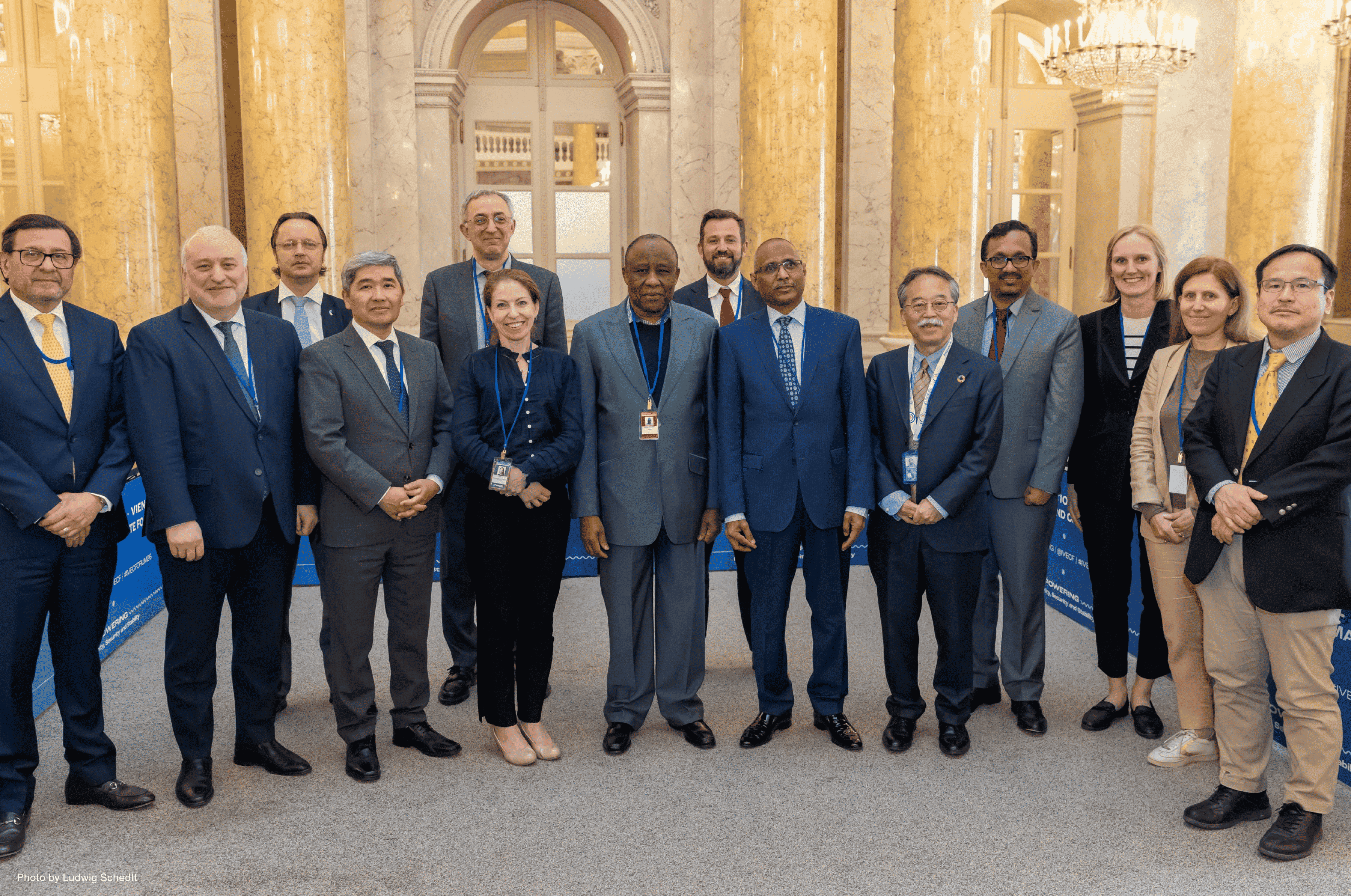
On the margins of the International Vienna Energy and Climate Forum (IVECF) 2026, the United Nations Industrial Development Organization (UNIDO) convened a roundtable “Rebuilding Futures: Green Industrialization in Crisis Contexts and Recovery.” With a solutions-oriented and forward-looking approach, the discussion focused on actionable partnerships, financing models and policy tools that can help post-crisis recovery through green industrial development. UNIDO’s work in Ukraine was highlighted as an example for other countries.
Yuko Yasunaga, UNIDO Deputy to the Director General and Managing Director of the Directorate of Corporate Services and Operations, presented UNIDO’s approach to green industrial recovery in Ukraine, starting with diagnosis, developing into a comprehensive programme and delivering through concrete projects in partnership with the private sector.
“UNIDO’s intervention in Ukraine began with an industrial diagnostic study conducted in 2023. This helped us understand the scale of the impact on Ukraine’s industry, identify and prioritize key sectors and highlight opportunities for sustainable and resilient recovery. It provided an important analytical foundation for various interventions in Ukraine. Building on these findings, UNIDO developed the Green industrial recovery programme for Ukraine 2024-2028, covering a wide range of industrial development areas. Under this programme, UNIDO is implementing 13 projects with contributions from various donors,” said Yasunaga.
He presented a flagship example, the UNIDO “Green industrial recovery project for Ukraine through technology transfer from and co-creation of new businesses with Japan's private industries,” financed by the Government of Japan. 47 sub-projects are being implemented, involving Japanese companies with advanced and innovative technologies to be applied in Ukraine. Following feasibility studies, projects that meet GO/STOP criteria move to pilot technology deployment and commercialization. This project not only introduces new technologies but also fosters partnerships between Japanese and Ukrainian companies, creating a basis for long-term cooperation.
“By combining evidence-based diagnostics, structured programmes, project implementation, private sector engagement and international partnerships, this approach offers a flexible model that can be adapted to different country needs, especially in post-crisis recovery. UNIDO sees strong potential to replicate this model in other countries,” added Yasunaga.
Yurii Vitrenko, Permanent Representative of Ukraine to the International Organizations in Vienna, presented how Ukraine is rebuilding its industrial base, while simultaneously aligning with EU green standards as part of its accession path.
“For Ukraine, green industrial recovery is not a concept, it is a priority. In the context of ongoing war, together with UNIDO, we are focusing on practical, scalable solutions on the ground, strengthening local capacities and supporting SMEs, including through a flagship Japan-funded project that delivers innovative, war-tailored initiatives and technologies. Effective recovery requires close coordination among governments, development partners, international and financial institutions, the private sector, as well as the UN system. Our shared objective is not only to rebuild what has been damaged, but also to lay the foundation for a greener, more resilient and more competitive industrial future,” noted Yurii Vitrenko.
Koji Terajima from Panasonic Ukraine presented how the company has maintained and expanded its presence in Ukraine throughout the hostilities and is directly engaged in the UNIDO-Japan project, focusing on high-efficiency heat pump solutions for municipal heating. This feasibility study explores the potential of decentralizing the old Soviet-style district heating system through the implementation of heat pump technology, contributing to energy savings, energy security, independence and decarbonization in Ukraine. Local municipalities will have the opportunity to adopt energy-efficient Japanese technology for heating and domestic hot water, moving away from outdated systems.
The roundtable highlighted how green industrialization can serve as a cornerstone of crisis recovery strategies, emphasizing the need to redesign systems for the future while drawing on real-world experiences, practical challenges and emerging solutions. Participants included the Minister of Industry and Entrepreneurship of Sri Lanka, the Palestinian Ambassador to Austria and Permanent Observer to the UN in Vienna, the Permanent Representative of Sudan to the UN in Vienna, representatives from the European Bank for Reconstruction and Development (EBRD), the Columbia Center on Sustainable Investment at Columbia University, the North-East Development Commission of Nigeria and others.
The session took place as part of IVECF 2026, held on 9-10 April 2026 in Vienna under the theme “Powering Prosperity, Security and Stability”. The Forum serves as a platform for advancing practical, implementation-oriented solutions at the intersection of energy, climate and industrial development.
Background information:
The International Vienna Energy and Climate Forum, previously known as the Vienna Energy Forum, is a solutions platform to accelerate low-emission, climate-resilient development around the world and facilitate multi-sectoral, multi-stakeholder and inter-disciplinary dialogue to advance sustainable energy development while promoting inclusiveness and the empowerment of women and youth.
Initiated in 2008, the Forum is co-organized by UNIDO, the Government of Austria and the International Institute for Applied Systems Analysis.
The “Green industrial recovery project for Ukraine through technology transfer from and co-creation of new businesses with Japan's private industries” is implemented by the United Nations Industrial Development Organization (UNIDO), under the Green industrial recovery programme for Ukraine (2024-2028), with the financial support of the Ministry of Economy, Trade and Industry of Japan (METI) and in partnership with the Ministry of Economy, Environment and Agriculture of Ukraine.
For further information, please contact:
Irma Juskenaite-Asmus, UNIDO Communications Expert